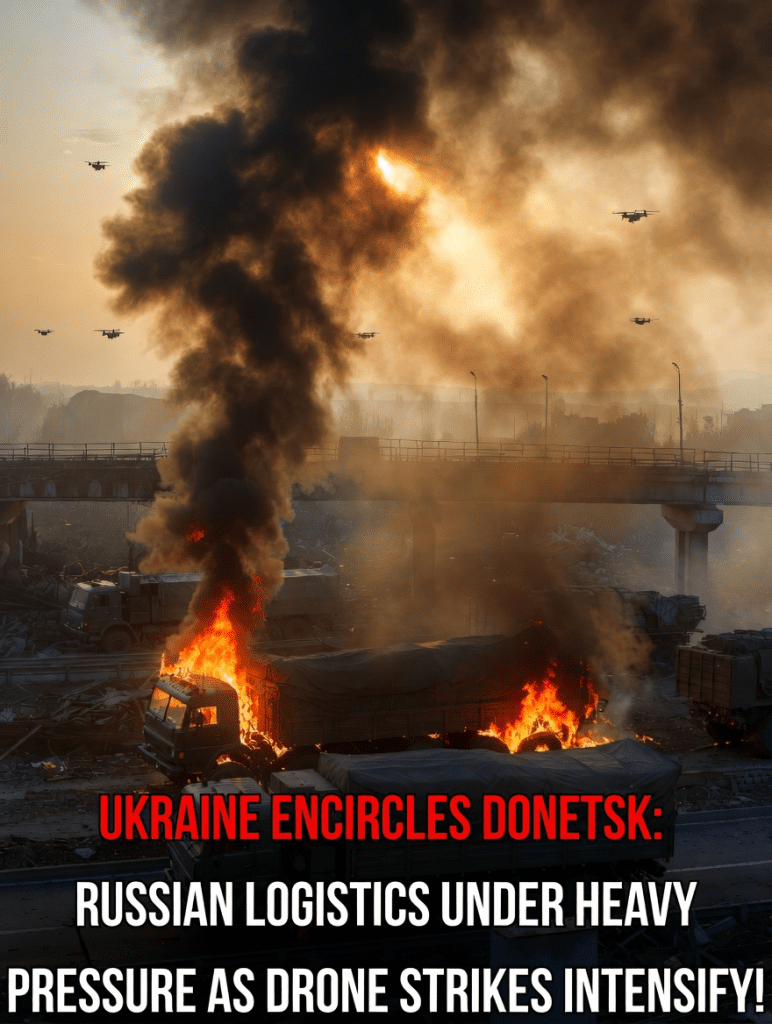
While global attention often focuses on the intense frontline clashes around Pokrovsk, Chasiv Yar, and the so-called “Fortress Belt” cities of Kramatorsk and Sloviansk, a parallel and increasingly sophisticated campaign is unfolding in the rear areas of Russian-occupied Donetsk Oblast. Ukrainian forces are using coordinated drone operations to disrupt Russian logistics, isolate Donetsk City, and weaken the foundation needed for any large-scale summer offensive.
This rear-area campaign represents a shift in modern warfare, where the battlefield extends far beyond the trenches. By establishing what Ukrainian sources describe as a “denial zone” stretching up to 60 kilometers behind the front lines, Ukraine aims to make sustained Russian occupation more costly and logistically unsustainable.
Creating a Denial Zone: The Drone Campaign
Ukrainian units have deployed a layered system of First-Person View (FPV) drones and longer-range strike drones to target Russian supply lines, fuel depots, ammunition storage, and command infrastructure. These operations go well beyond opportunistic strikes — they form a deliberate strategy to sever the “connective tissue” that keeps Russian forces operational.
Supply trucks, which are essential for moving ammunition, fuel, food, and spare parts, have become prime targets. Even convoys operating 40 to 60 kilometers from the active front lines now face significant risk. Ukrainian operators use real-time intelligence, often provided by reconnaissance drones, to identify and strike high-value targets with precision.
Notable targets reportedly include:
- Fuel depots supporting mechanized units
- Temporary command posts
- Iskander missile system bases
- Railway sidings and truck staging areas used for resupply
This systematic pressure seeks to force Russian commanders to divert resources toward rear-area defense, reduce the tempo of frontline assaults, and create shortages that affect combat effectiveness.
Strategic Importance of Isolating Donetsk
Donetsk City serves as both a symbolic and practical hub for Russian operations in the region. Controlling the city and its surrounding transport network is critical for projecting power across Donetsk Oblast. By disrupting the flow of supplies into the city and adjacent occupied territories, Ukraine aims to constrain Russian ability to mass forces for a major summer push.
Military analysts note that modern armies require enormous amounts of matériel to sustain high-intensity combat. A single brigade can consume hundreds of tons of supplies daily. When logistics are strained, units face reduced artillery support, limited fuel for vehicles, and lower morale among troops operating under constant threat.
The drone campaign complements Ukraine’s defensive efforts in the “Fortress Belt.” While ground forces hold fortified positions, rear-area strikes aim to prevent Russia from building up the resources needed to overwhelm those defenses.
The Evolution of Drone Warfare in Ukraine
Since 2022, both sides have rapidly innovated in unmanned aerial systems. Ukraine has excelled in developing low-cost, highly effective FPV drones that can carry explosive payloads and strike with pinpoint accuracy. Improvements in range, electronic countermeasures resistance, and operator training have extended their reach deep into rear areas.
This approach offers several advantages:
- Lower cost compared to traditional missiles
- High precision with reduced collateral damage in some scenarios
- Ability to adapt quickly to changing conditions
- Psychological impact on enemy logistics personnel
Russia has responded by increasing air defenses, using electronic jamming, deploying decoys, and dispersing supply depots. The ongoing contest between Ukrainian strike capabilities and Russian protective measures continues to shape the battlefield.
Challenges and Limitations
While the drone campaign has achieved notable successes, it faces constraints. Weather conditions, Russian electronic warfare, and improved air defenses can reduce effectiveness. Russia has also adapted by moving supplies at night, using civilian vehicles as cover in some areas, and increasing protection around key routes.
Both sides continue to suffer losses. Ukrainian drone operators face risks from Russian counter-drone systems, and the constant need for new drones places pressure on Ukraine’s production capacity and international supply chains.
Humanitarian and Civilian Considerations
Any military operation in populated or semi-populated areas carries risks for civilians. Donetsk Oblast has seen significant destruction since 2014, with many communities already displaced or living under difficult conditions. Disruptions to supply lines can affect not only military operations but also the availability of essential goods for remaining civilian populations.
International humanitarian organizations continue to call on all parties to minimize harm to civilians and ensure safe passage for aid. The prolonged nature of the conflict has created ongoing challenges for access to healthcare, clean water, and basic services across the region.
Broader Context of the Donetsk Campaign
As of May 2026, the situation in Donetsk remains highly dynamic. Russian forces maintain pressure on several axes, while Ukrainian units focus on defensive resilience and targeted counteractions. The summer months ahead may bring improved ground mobility, potentially leading to increased intensity on both sides.
The rear-area drone campaign reflects a broader trend in the conflict: the increasing importance of logistics and deep strikes. Success in modern warfare often depends as much on sustaining supply lines as on direct combat engagements.
Implications for the Future
If Ukraine can maintain and expand its denial zone around Donetsk, it may force Russia to reconsider the scale and timing of any planned offensives. Conversely, if Russia successfully mitigates these threats through better defenses and alternative supply methods, it could regain momentum in the region.
The conflict continues to demonstrate how asymmetric tactics, technological innovation, and logistical resilience shape outcomes in high-intensity warfare. Both militaries are adapting rapidly, with lessons being observed by defense establishments worldwide.
A Continuing Human Cost
Behind every strike and every logistical challenge are human stories. Soldiers on both sides face difficult conditions, while civilians bear the heaviest burden of a conflict now entering its fifth year. Families remain separated, communities are fractured, and the path to recovery grows longer with each passing month.
As developments in Donetsk unfold, international observers continue to monitor the situation closely. Diplomatic efforts, though limited, remain essential in seeking pathways toward de-escalation and eventual resolution that prioritizes civilian safety and regional stability.
This article is based on open-source reports, military analyses, and statements from both sides as of May 2026. The situation remains fluid, with information subject to verification challenges inherent in active conflict zones. Readers are encouraged to consult multiple credible sources for ongoing updates.