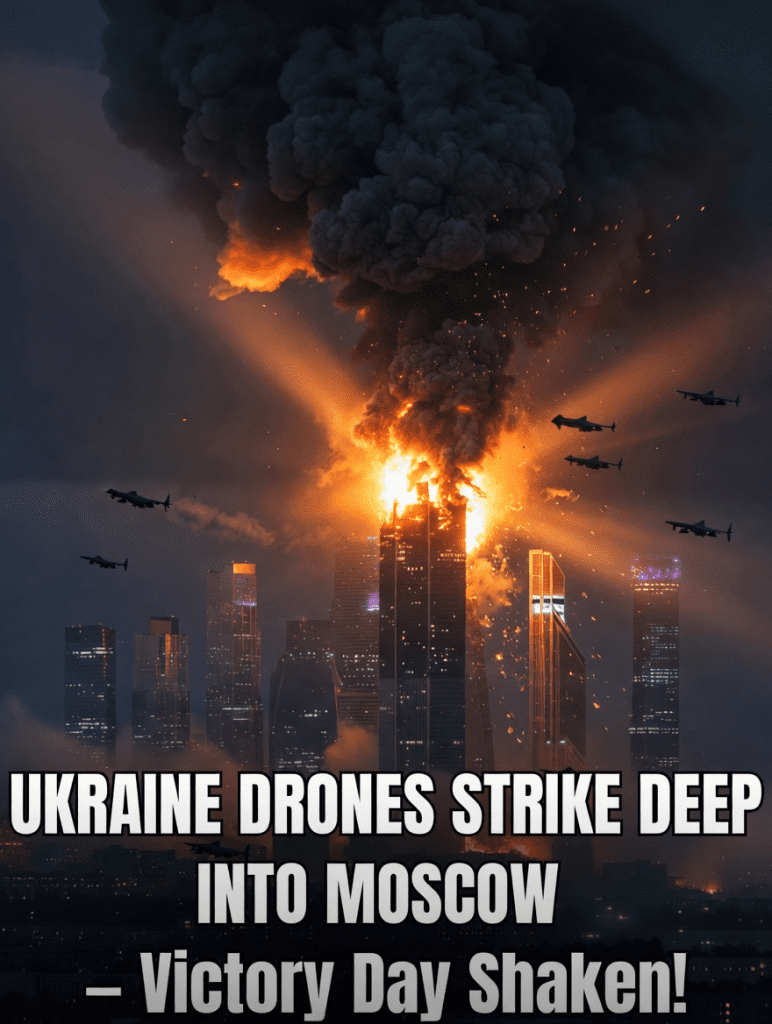
Reports indicate that Ukrainian forces conducted drone operations targeting areas in and around Moscow, including strikes on high-rise buildings in the Russian capital’s business district. The incidents have heightened security concerns in Russia, particularly ahead of the annual Victory Day celebrations on May 9, 2026, leading to a noticeably scaled-back military parade with reduced displays of heavy equipment.
These events reflect the expanding reach of long-range unmanned systems in the ongoing Russia-Ukraine conflict and the increasing pressure on rear-area infrastructure and urban centers.
Details of the Reported Strikes
According to available information, Ukrainian drones reached the Moscow region and struck high-rise buildings in the business district. Russian emergency services responded quickly, with reports of damage to structures and activation of large-scale security protocols. Russian authorities stated that air defense systems engaged multiple threats, though some drones reportedly reached their targets.
The timing of the incidents, just days before Victory Day — a major national holiday commemorating the Soviet Union’s victory in World War II — added symbolic and practical weight to the events. In response, Russian officials implemented enhanced security measures across Moscow and other major cities, including flight restrictions, increased patrols, and a more modest parade format compared to previous years.
Independent verification of exact damage and casualties remains limited due to information controls in the region. Both sides have issued statements regarding the operations, consistent with the information environment typical of active conflicts.
Victory Day in a Time of Heightened Tension
Victory Day on May 9 is one of Russia’s most important public holidays, traditionally featuring large military parades in Red Square and across the country. In 2026, the celebrations were conducted under stricter security conditions. The reduction in heavy equipment displays and public gatherings reflects the challenges of maintaining large-scale events amid ongoing drone threats.
The contrast between the symbolic importance of the holiday and the reality of active military operations underscores the complex internal and external pressures facing Russia as the conflict continues into its fifth year.
Expanding Reach of Ukrainian Long-Range Capabilities
The reported strikes on Moscow-area targets demonstrate significant advancements in Ukrainian unmanned aerial systems. Over the past year, Ukraine has developed and deployed longer-range drones capable of reaching deep into Russian territory, sometimes exceeding 1,000–1,800 kilometers from the front lines.
These operations form part of a broader strategy of targeting rear-area assets, including military infrastructure, energy facilities, and logistical hubs. By extending strikes into central Russia, Ukraine aims to disrupt operations, impose economic and psychological costs, and force Russia to divert defensive resources away from the front lines.
Russia has responded by strengthening air defenses around major cities and critical infrastructure, increasing electronic warfare capabilities, and conducting its own long-range strikes on Ukrainian territory. This mutual pattern of deep strikes has become a defining feature of the current phase of the conflict.
Challenges in Urban Air Defense
Protecting large urban centers like Moscow from drone attacks presents unique difficulties:
- Vast geographic area and dense civilian infrastructure
- High volume of potential targets requiring constant monitoring
- Low-flying, small-signature drones that are difficult to detect
- Need to balance military defense with civilian safety
These challenges have prompted both countries to invest heavily in new detection systems, interceptor drones, and electronic countermeasures. The incidents around Moscow highlight how modern conflicts increasingly blur the lines between frontline and rear areas.
Broader Military Context in May 2026
The Moscow strikes occur alongside intense fighting across multiple fronts in Ukraine, particularly in Donetsk Oblast. Both sides report daily engagements involving infantry, artillery, drones, and missile systems. Logistics, manpower, and air defense remain critical factors influencing operational capabilities.
Russia maintains advantages in certain areas of personnel and industrial production, while Ukraine continues to demonstrate innovation in unmanned systems and integration of Western-supplied equipment. The high consumption rate of munitions and equipment places sustained pressure on both economies and supply chains.
Summer weather conditions in 2026 are expected to improve mobility and potentially increase the tempo of operations across the theater.
Humanitarian and Civilian Safety Concerns
As drone operations reach deeper into urban areas, risks to civilian populations increase significantly. Strikes in or near densely populated districts can cause collateral damage, disrupt essential services, and create widespread anxiety. Russian authorities have reported civilian impacts from Ukrainian strikes, while Ukraine continues to document civilian casualties and infrastructure damage from Russian attacks.
Protecting civilians in both countries remains a major humanitarian priority. International humanitarian organizations emphasize the importance of adhering to international humanitarian law, particularly the principles of distinction, proportionality, and precaution in attacks.
Millions of people across Ukraine and affected regions of Russia continue to live with the daily threat of drones and missiles. Displacement, economic hardship, and psychological trauma remain widespread after more than three years of full-scale war.
International Monitoring and Regional Implications
The international community is closely watching developments around Moscow and the broader conflict. Incidents involving strikes on capital cities raise concerns about potential escalation and broader security implications. Many governments and organizations have called for de-escalation and renewed diplomatic efforts to reduce civilian suffering.
The conflict continues to affect global markets, energy security, food supplies, and international relations. Diplomatic channels remain active, though significant obstacles persist regarding territorial issues, security guarantees, and accountability.
The Evolving Nature of Modern Warfare
The reported drone operations near Moscow exemplify several key trends in contemporary conflict:
- Extension of the battlefield through long-range unmanned systems
- Increasing importance of rear-area security and infrastructure protection
- Cost asymmetry between low-cost drones and expensive traditional defenses
- Rapid technological adaptation by both sides
These dynamics are being studied by military analysts worldwide and are likely to influence defense strategies and doctrines in future conflicts.
Economic and Logistical Pressures
Both Russia and Ukraine face substantial economic challenges from the prolonged war. Strikes on infrastructure add to repair costs, disrupt supply chains, and divert resources from other priorities. Sustaining high-intensity operations requires enormous quantities of fuel, ammunition, and equipment, placing strain on national budgets and industrial capacities.
The human and economic costs continue to accumulate, reinforcing the need for eventual diplomatic resolution that can address underlying security concerns while prioritizing reconstruction and civilian well-being.
Looking Ahead
The situation in Moscow and across the broader theater remains fluid. Russian authorities are expected to maintain heightened security measures in the coming days, while Ukraine continues to refine its long-range capabilities. Future developments will likely depend on each side’s ability to adapt defensively and offensively in the aerial domain.
As summer 2026 progresses, increased operational activity is possible across multiple fronts. International diplomatic and humanitarian efforts will remain important in the background, even as military operations continue.
The shared hope among many civilians and global observers is for de-escalation and a negotiated path toward lasting stability that can reduce suffering and allow for recovery in the region.
This article is based on reports from Russian authorities, Ukrainian military sources, and international media coverage as of May 2026. Information from active conflict zones is often contested and should be cross-checked with multiple credible sources. Our thoughts remain with all civilians and families affected by the ongoing war in Ukraine and Russia.