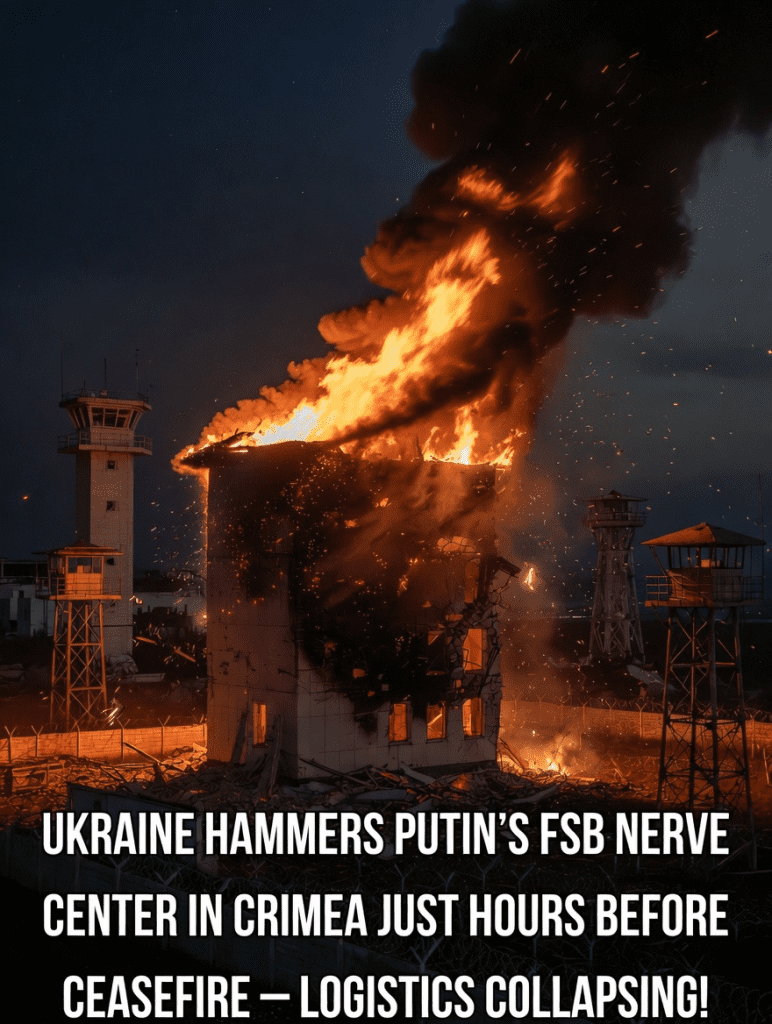
As Russia prepared for its annual Victory Day commemorations on May 9, 2026, Ukrainian forces carried out a series of precision strikes on military and logistical targets in occupied Crimea and deep inside Russian territory. The operations highlight the continued escalation of long-range strikes and the challenges both sides face in securing rear areas amid ongoing hostilities.
These developments occurred against a backdrop of high military activity across the front lines and renewed international attention on the prospects for any ceasefire or diplomatic progress in the conflict.
Strikes on Crimea and Russian Territory
Ukrainian military sources reported successful strikes on logistical infrastructure in occupied Crimea, including fuel depots, ammunition storage facilities, and transport nodes supporting Russian operations in southern Ukraine. Additional long-range drone and missile operations targeted assets inside Russia proper, focusing on military-related sites.
The timing of the strikes, just before and around Victory Day, added symbolic weight to the actions. Russia responded by tightening security measures significantly for the Moscow parade, with heavy restrictions on public gatherings, flight bans over the capital, and enhanced air defense deployments across multiple regions.
Russian authorities confirmed some damage from Ukrainian attacks and reported intercepting a number of incoming drones and missiles. Casualty figures and the full extent of damage remain difficult to verify independently due to restrictions on information from both sides.
Zelenskyy’s Frontline Visit and Statements
Ukrainian President Volodymyr Zelenskyy visited troops on the frontline during this period, emphasizing the need for stronger logistics, continued innovation in defense technology, and a firm response to Russian military actions. He described Ukraine’s strikes as a “mirror response” to ongoing Russian attacks on Ukrainian cities and infrastructure.
In his public remarks, Zelenskyy stressed the importance of protecting Ukrainian soldiers and civilians while maintaining pressure on Russian supply lines. He highlighted recent advancements in domestic drone production and the integration of Western-supplied long-range systems as critical factors in Ukraine’s defensive strategy.
The visit served both as a morale boost for troops and a public message that Ukraine remains resolute despite the prolonged nature of the conflict.
Victory Day in a Time of War
Russia’s Victory Day parade on May 9 commemorates the Soviet Union’s victory over Nazi Germany in 1945. In 2026, the event was held under stricter security protocols than in previous years. The parade in Moscow featured reduced military hardware displays and a heavy security presence. Similar commemorations in other Russian cities were also scaled back or conducted with enhanced protection.
The contrast between Russia’s internal celebrations and the active military operations underscores the complex realities of the ongoing war, now entering its fifth year.
Strategic Importance of Rear-Area Operations
Both sides have increasingly focused on targeting logistics and rear infrastructure. For Ukraine, disrupting supply lines in Crimea and Russia aims to reduce Russia’s ability to sustain offensive operations in Donetsk and other eastern regions. For Russia, long-range strikes on Ukrainian energy facilities and military sites seek to degrade Ukraine’s capacity to defend and counterattack.
Military analysts note that this mutual emphasis on deep strikes reflects the evolving nature of the conflict:
- Greater reliance on drones and precision-guided munitions
- Challenges in protecting vast territories and long supply chains
- The high cost of modern warfare, with both economies under strain
The “rear-area war” has become as strategically significant as frontline battles in determining long-term sustainability.
The Humanitarian and Civilian Impact
As strikes extend deeper into both countries, civilian populations face increased risks. In Ukraine, Russian attacks on energy infrastructure have caused power shortages and hardship for millions. In Russia, regions previously far from the conflict are now experiencing direct effects from Ukrainian long-range operations.
Millions of people remain displaced across the region. Humanitarian organizations continue to provide aid where access is possible, but active combat zones severely limit delivery. The psychological toll of living under constant threat of drones and missiles adds another layer to the human cost of the war.
International humanitarian law calls on all parties to minimize harm to civilians and civilian infrastructure. Both sides have reported civilian casualties from the other’s strikes, highlighting the tragic realities of prolonged conflict.
International Monitoring and Ceasefire Discussions
Global observers, including governments and international organizations, continue to monitor the situation closely. Periodic discussions about potential ceasefires or peace negotiations have taken place, though significant obstacles remain on core issues such as territorial integrity, security guarantees, and accountability.
Western countries have reiterated support for Ukraine while urging diplomatic efforts. Some nations have called for de-escalation to reduce civilian suffering and prevent further economic disruption on a global scale.
The conflict continues to influence international relations, energy markets, food security, and security alliances far beyond Eastern Europe.
Broader Context of the Conflict in May 2026
Fighting remains intense in several sectors, particularly in Donetsk Oblast, where both sides report high levels of activity involving infantry, artillery, and drone operations. Summer weather conditions are expected to improve mobility and potentially increase the tempo of operations in the coming months.
Both Russia and Ukraine face challenges related to manpower, equipment sustainability, and economic pressures. Russia maintains advantages in certain areas of production and personnel, while Ukraine benefits from technological innovation and international support.
The war has caused enormous loss of life and destruction on both sides. Independent estimates suggest hundreds of thousands of military casualties overall, though exact figures are difficult to confirm. The societal and economic impacts will likely take decades to fully recover from.
Reflections on the Path Forward
The latest strikes and security measures around Victory Day illustrate the entrenched nature of the conflict. While both sides continue military operations, the shared hope for peace persists among civilians and parts of the international community.
Achieving any lasting resolution will require addressing fundamental security concerns, territorial questions, and humanitarian needs. In the meantime, efforts to protect civilians, maintain diplomatic channels, and support humanitarian aid remain critical.
As events continue to unfold rapidly, accurate information and balanced analysis are essential for understanding this complex and tragic conflict.
This article is based on official statements from both Ukrainian and Russian sources, verified open-source reports, and international media coverage as of May 2026. Information from active war zones is often contested and should be cross-checked with multiple credible outlets. Our thoughts remain with all civilians and families affected by the ongoing war in Ukraine and Russia.