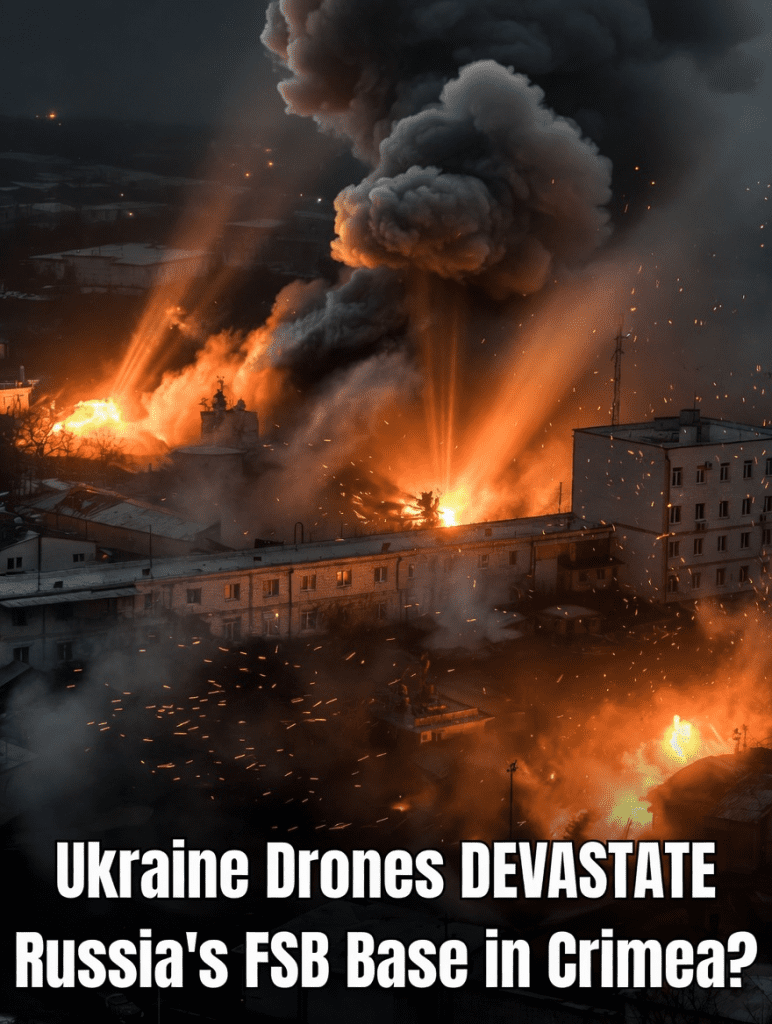
Reports indicate that Ukrainian forces carried out a drone strike on a facility belonging to Russia’s Federal Security Service (FSB) in occupied Crimea. The operation reportedly caused explosions and fires at the site, disrupting infrastructure used for intelligence and security operations in the region.
This incident adds to the pattern of long-range strikes on military and security assets in Crimea and highlights the expanding reach of unmanned aerial systems in the ongoing Russia-Ukraine conflict.
Details of the Reported Strike
According to Ukrainian military sources and open-source analysts, drones targeted an FSB compound in Crimea. Explosions and subsequent fires were observed at the facility. Russian authorities confirmed that air defenses were activated in the area and that emergency services responded to the scene. No official detailed casualty or damage assessments have been released by Russian officials.
The FSB, Russia’s primary security and intelligence agency, maintains a significant presence in Crimea, which has been under Russian control since 2014. Facilities like the one reportedly struck support coordination of security operations, border control, and counter-intelligence activities across the peninsula.
Independent verification of the full extent of damage remains limited due to restricted access in occupied territories and the challenges of confirming information from active conflict zones.
Strategic Importance of Crimea and Security Infrastructure
Crimea holds high strategic value for Russia. The peninsula serves as a major naval base for the Black Sea Fleet, hosts multiple airfields, and functions as a logistical hub supporting operations in southern Ukraine. Security and intelligence facilities play a critical role in maintaining control, protecting supply lines, and monitoring activities in the Black Sea region.
Targeting such sites aims to disrupt coordination, intelligence gathering, and operational support. By focusing on rear-area assets, Ukraine seeks to impose costs on Russian sustainment capabilities and limit their ability to project power from the peninsula.
The Kerch Strait, Crimean Bridge, and various ports have been focal points of previous strikes for similar reasons. Repeated operations in the region demonstrate Ukraine’s emphasis on weakening Russian logistics and command structures in this strategically vital area.
Evolution of Drone Warfare in the Black Sea Theater
The reported strike on the FSB facility reflects the continued development of Ukrainian long-range drone capabilities. Ukraine has invested heavily in domestic production of unmanned systems, ranging from small tactical drones to longer-range platforms capable of striking targets deep in occupied or Russian territory.
Key trends in 2026 include:
- Increased use of coordinated multi-drone attacks
- Improved navigation and survivability features to counter air defenses
- Greater integration of intelligence, surveillance, and reconnaissance (ISR) for precise targeting
- Focus on logistical, command, and security infrastructure
Russia has responded by strengthening air defenses around key sites in Crimea, dispersing assets, and enhancing electronic warfare capabilities. The ongoing contest between strike systems and defensive measures continues to drive rapid innovation on both sides.
Military analysts note that drone operations have become a central element of the conflict, offering a relatively cost-effective way to challenge larger, more traditional military forces. The Black Sea region has emerged as a particularly active theater for these technologies.
Broader Military Context in May 2026
The incident in Crimea occurs amid persistent fighting across multiple fronts in Ukraine, with notable activity in Donetsk Oblast and other eastern and southern regions. Both sides report daily engagements involving infantry, artillery, drones, and missile systems.
Logistics, intelligence, and supply line protection remain critical factors. Russia maintains numerical advantages in certain areas, while Ukraine relies on technological adaptation and asymmetric tactics. The high consumption rate of equipment and munitions places sustained pressure on both sides’ resources and industrial capacities.
Summer weather conditions in 2026 are expected to improve mobility and potentially increase the tempo of operations, including aerial and naval activities in the Black Sea.
Humanitarian and Civilian Impact
Military operations in Crimea affect civilian populations on the peninsula. Strikes on or near security and military facilities can lead to power disruptions, transportation challenges, and risks to non-combatants. Both Ukrainian and Russian authorities have reported civilian casualties and infrastructure damage from strikes throughout the conflict.
The prolonged war has created significant humanitarian challenges across the region, including displacement, economic hardship, and strain on essential services. International humanitarian organizations continue to provide aid where access is possible, though active combat zones severely limit these efforts.
Protecting civilians and adhering to international humanitarian law remain key concerns. Observers emphasize the importance of distinguishing between military and civilian targets and taking precautions to minimize harm to non-combatants.
International Monitoring and Regional Implications
The international community continues to monitor developments in Crimea and the Black Sea region closely. Incidents involving strikes on security infrastructure raise concerns about escalation risks and broader stability in the area. The Black Sea’s importance for grain exports, energy routes, and maritime security affects multiple countries beyond the immediate conflict parties.
Turkey, which controls access through the Bosporus Strait, plays a notable diplomatic role in managing tensions related to naval and aerial activities. Many governments and organizations have called for de-escalation and renewed efforts toward diplomatic solutions.
While periodic discussions about ceasefires occur, significant differences persist on core issues such as territorial control, security guarantees, and accountability. Global attention remains focused on the humanitarian situation and the conflict’s wider economic effects.
Economic and Logistical Dimensions
Strikes on logistical and security facilities add to the costs of sustaining military operations. Repair work, enhanced security measures, and asset dispersal require significant resources. For Russia, maintaining control and supply lines to Crimea has become increasingly complex under sustained pressure.
Both economies face challenges from the prolonged war. The high consumption of drones, missiles, and defensive systems strains industrial capacity and national budgets. Economic resilience and the ability to sustain long-term operations are becoming increasingly important factors.
Technological Innovation and Future Trends
The reported strike exemplifies broader trends in modern warfare:
- Proliferation of affordable, long-range unmanned systems
- Extension of the battlefield into deep rear areas
- Growing importance of intelligence and logistical targets
- Rapid cycle of innovation between strike and defense technologies
Defense establishments worldwide are studying the Russia-Ukraine conflict for insights into future conflicts. The effectiveness of drone operations against traditional military infrastructure is of particular interest to military planners globally.
Looking Ahead
The situation in Crimea remains tense, with both sides expected to continue operations aimed at disrupting the other’s capabilities. Russia will likely strengthen defenses around key facilities, while Ukraine continues to develop and deploy new unmanned systems.
As summer 2026 progresses, activity in the Black Sea region and across the broader front may intensify. Diplomatic and humanitarian efforts will remain important in parallel with military developments.
The conflict, now in its fifth year, continues to demonstrate the complex interplay of technology, logistics, and human factors. The shared hope among many civilians and international actors is for eventual de-escalation and a negotiated resolution that can reduce suffering and address underlying security concerns while prioritizing civilian protection and long-term recovery.
This article is based on reports from Ukrainian military sources, Russian official statements, open-source analysts, and international media coverage as of May 2026. Information from active conflict zones is often contested and should be cross-checked with multiple credible sources. Our thoughts remain with all civilians and families affected by the ongoing war in Ukraine and Russia.